
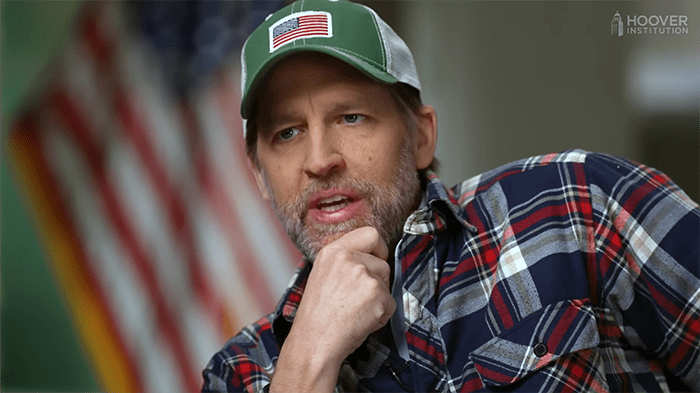
Ben Sasse has been in the news lately because he is dying. The most noteworthy appearances by the former Nebraska senator occurred last month on “60 Minutes” and in a related “Things That Matter” town hall hosted by CBS News.
Sasse also recently started a podcast that he had planned before discovering last December that he has pancreatic cancer. Rather than canceling the show, he and his co-host just renamed it to “Not Dead Yet,” a Monty Python reference befitting Sasse’s newfound gallows humor.
The title is ironically fitting for another reason. Sasse has been talking a lot about death. One of his recurring themes is death as “the last enemy” (see this interview at the 48:40 mark for a discussion in the context of Jesus weeping at Lazarus’ tomb).
I want to explore that now in the context of Christ’s death and the Lord’s Supper that memorializes it.
The phrase “the last enemy” to describe death comes from 1 Corinthians 15, where Paul explains the resurrection. It’s a meaty phrase from a meaty paragraph inside a meaty chapter of scripture.
To fully appreciate it, you have to follow Paul’s train of thought back to Adam because death entered this life through him. “By a man death came,” Paul wrote in verse 21. “In Adam all die,” he added in verse 22.
A bit later Paul said, “The first man, Adam, became a living person.” That’s a reference to God breathing life into Adam’s nostrils (Genesis 2:7). Adam was perfect at that point — immortal, with no prospect of death while He had access to the Tree of Life.
Then Satan, the serpent of old, slithered into the Garden of Eden, and Adam’s fate changed forever. So did ours, not because of what Adam did but because we’re as weak as he was. The last enemy comes for us all, “for all have sinned and fall short of the glory of God” (Romans 3:23).
The good news for us is on the flip side that Paul described in 1 Corinthians 15. “By a Man also came the resurrection of the dead,” he said in verse 21. Then in verse 22, “so also in Christ all will be made alive.” Like the first Adam in Paul’s metaphor, we were dead in our sins. But as he later put it, “the last Adam was a life-giving spirit.”
The bad news for that last Adam, the Son of Man, is at this table, symbolically speaking — His broken body (the unleavened bread), and His spilt blood (the fruit of the vine).
In due time, as Paul told the Corinthians, Christ will hand over the kingdom to God. He will abolish all rule and all authority and power. He will put all enemies, including the last enemy of death, under His feet. But in His time in the flesh, in this realm, He had to endure great physical and emotional pain because we sinned. He never did. We did — and he paid the price for it.
The last enemy had the edge until Jesus went to the cross. But on that fateful day God “canceled [our] certificate of debt” (Colossians 2:13-15), and death has been dying ever since.
When John fell at Jesus’ feet like a dead man in the opening vision of Revelation, Jesus reassured him: “Do not be afraid; I am the first and the last, and the living One; and I was dead, and behold, I am alive forevermore, and I have the keys of death and of Hades.”
John mentioned Death and Hades again at the end of Revelation when he saw a vision at the throne of God. The Book of Life was opened, Death and Hades gave up their captives, and the dead were judged according to their deeds. “Then Death and Hades were thrown into the lake of fire,” John wrote. “This is the second death” (Revelation 20:11-15).
Jesus conquered death at Calvary. He is already Lord of the last enemy. It’s just a matter of time eternal for John’s vision to become reality. Jesus will abolish death and resurrect His own.
Which is why Paul penned these comforting words at the end of 1 Corinthians 15:
But when this perishable puts on the imperishable, and this mortal puts on immortality, then will come about the saying that is written: “Death has been swallowed up in victory. Where, o death, is your victory? Where, o death, is your sting?” (Isaiah 25:8; Hosea 13:14) The sting of death is sin, and the power of sin is the Law; but thanks be to God, who gives us the victory through our Lord Jesus Christ.
Victory in Jesus — that’s the happy ending to the sad story we remember every Sunday. We don’t deserve it. Jesus suffered greatly to give it to us. But He won the battle, and we will win the war if we fight with Him to the end.
ADVERTISEMENT
For more ideas to share at the Lord’s Supper, see:
– Christ Before Our Eyes: 52 Readings to Draw Closer to Christ at the Lord’s Supper
– Beneath the Cross: Essays and Reflections on the Lord’s Supper



Pingback: Lord's Supper Talks | Bible Study Page